States defy autonomy ruling, retain control of LG allocations
States defy autonomy ruling, retain control of LG allocations
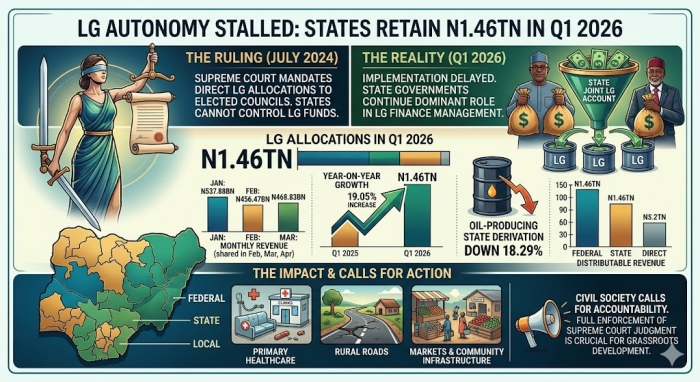
Nearly two years after a landmark Supreme Court ruling intended to liberate local government finances, state governors continue to exercise dominant control over the third tier of government. Fresh data compiled from the Federation Account Allocation Committee and the National Bureau of Statistics reveals that local government councils were allocated 1.46 trillion naira in the first quarter of 2026. However, these funds were processed through the traditional distribution structures rather than being paid directly to democratically elected councils as mandated by the apex court on July 11, 2024. This persistent delay suggests that the constitutional authority of states to manage council finances remains unchallenged in practice, even though the court explicitly declared such control illegal.
The financial figures show a significant 19.05 percent increase in allocations compared to the 1.23 trillion naira recorded during the same period in 2025. This rise occurred despite a slight dip in the total distributable revenue for the entire federation, which fell from 7.40 trillion naira to 6.97 trillion naira year-on-year. While the federal and state governments also saw their direct shares grow, the local councils’ 20.99 percent stake of the national pie remains tied to the State Joint Local Government Accounts. Critics argue that this arrangement allows governors to treat grassroots funding as an extension of state budgets, effectively neutralizing the impact of the increased revenue.

The volatility of the monthly disbursements further complicates the situation for local administrations. Allocations peaked at 537.88 billion naira in February before dropping by over 15 percent to 456.47 billion naira in March, reflecting the unstable nature of statutory and Value Added Tax receipts. For local governments tasked with maintaining primary healthcare, rural roads, and sanitation, this combination of financial instability and lack of autonomy creates a bottleneck for service delivery. Analysts maintain that the influx of cash will do little to improve community infrastructure as long as councils lack the independent authority to plan and execute their own spending.


Civil society groups are now intensifying calls for a full enforcement of the judicial order to curb corruption and stimulate local economies. Emeka Ononamadu of the Citizens Centre for Integrated Development and Social Rights recently emphasized that true autonomy is the only way to ensure that these billions translate into security and development for ordinary Nigerians. As it stands, the first-quarter data for 2026 confirms a troubling trend where local governments are receiving more money on paper, but the promised era of financial independence remains a distant prospect.


- SOURCE: NEWS SCROLL