Detty December fuels major forex inflows while sparking cultural debate
Detty December fuels major forex inflows while sparking cultural debate
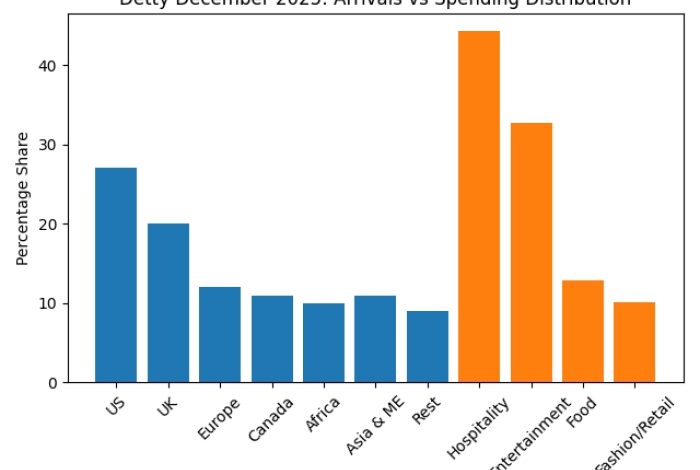
The United States became the leading source of international visitors to Lagos during the 2025 Detty December season, surpassing the United Kingdom for the first time. Diaspora spending surged to N396.54 billion, according to a report by MO Africa Co titled The Economics of Euphoria: Lagos’ Detty December 2025. Travellers departing from the US accounted for 27 percent of total arrivals, highlighting a shift in diaspora travel patterns and the growing influence of Nigerian-American communities on Lagos’ global cultural appeal.
The report links this change partly to the viral exposure of previous editions, which created a strong fear of missing out (FOMO) among younger diaspora audiences. Many US-based visitors travelled from cities like Houston and Atlanta, often connecting through Europe and the Middle East, illustrating the global scale and connectivity surrounding the event.

Outside the US and UK, Europe contributed 12 percent of arrivals, Canada 11 percent, Africa 10 percent, while Asia, the Middle East, and other regions made up the remaining 20 percent—further cementing Lagos’ reputation as an international cultural hotspot.


Between mid-November 2025 and January 10, 2026—a 55-day period—participation reached an estimated 3.6 million people. More than 70 percent were Gen Z and Millennials, underscoring the role of digital media, music exports, and social platforms in positioning Lagos as a global entertainment hub.


Diaspora visitors accounted for 55 percent of total consumer spending, injecting N396.54 billion into the economy. The hospitality sector captured the largest share at N175.40 billion (44.23 percent), benefiting hotels, short-let apartments, and property owners. Entertainment and nightlife followed with N129.55 billion (32.67 percent), highlighting the strength of Nigeria’s creative industries. Food and dining contributed 12.91 percent, while fashion, retail, and wellness sectors shared the remainder, demonstrating widespread economic spillovers across SMEs, transport operators, logistics providers, and informal vendors.
In addition, diaspora travellers spent approximately $384.5 million on air travel. While this represents a significant outflow to international airlines, it also reflects strong global mobility tied to Nigeria’s cultural exports. Economic activity was concentrated in Victoria Island, Ikoyi, and Lekki, where high-value transactions dominated, while mainland Lagos saw higher attendance across events and social gatherings.
The influx of visitors pushed Lagos to about 238 percent of its designed capacity, exposing infrastructure challenges such as traffic congestion, sanitation pressure, increased waste, and strained transport systems. The report also estimated N19 billion in spending on logistics, security, and operations, revealing additional layers of economic activity supporting the ecosystem.
Data from the Lagos State Ministry of Tourism, Arts, and Culture showed that the 2024 edition generated $71.6 million across hospitality, tourism, and entertainment. The significant growth recorded in 2025 points to rising global demand for Nigeria’s cultural experiences and positions Detty December as a potential non-oil revenue stream capable of boosting employment, tax revenue, and SME growth.
From a broader economic perspective, the season provides a strong boost to foreign exchange inflows, benefiting aviation, fintech, hospitality, transportation, fashion, advertising, and event production. Increased spending in urban real estate—especially short-let properties—also strengthens Lagos’ attractiveness for investment, reinforcing its status as a cultural capital drawing diaspora funds beyond traditional remittances.
However, the rapid expansion of Detty December is not without concerns. The event is increasingly shaped by Western pop culture influences, visible in music, fashion, nightlife, and consumer behaviour. The dominance of Gen Z diaspora participants has accelerated the blending of Nigerian culture with American and British trends, often promoting luxury consumption patterns that may not align with local economic realities.
Critics warn that this growing commercialisation risks diluting traditional values, encouraging excessive spending, and fostering social pressures tied to status display and nightlife culture.
While Detty December enhances Nigeria’s global cultural relevance and strengthens the service economy, it also presents a key challenge: how to effectively channel diaspora-driven spending into long-term economic development without deepening reliance on Westernised lifestyle models. The policy focus, therefore, should be on converting this seasonal boom into sustained growth through infrastructure investment, creative industry funding, and expanded tourism capacity—ensuring lasting economic impact beyond short-term consumption.
SOURCE: NEWS SCROLL