Opposition Push for Single Candidate Ahead of 2027 Elections
Opposition Push for Single Candidate Ahead of 2027 Elections
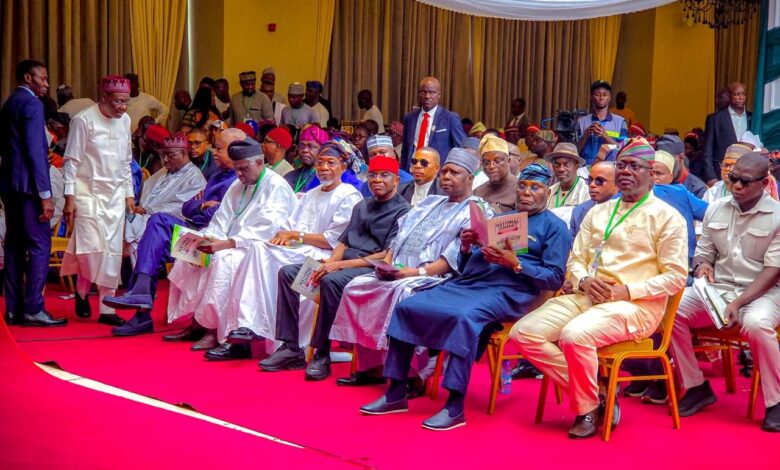
Nigeria’s opposition may finally be closing ranks.
At a high-stakes summit in Ibadan on Saturday, some of the country’s most influential political figures signalled a major shift ahead of the 2027 general elections—one that could see rival parties unite behind a single presidential candidate to challenge the ruling All Progressives Congress (APC).
In a strongly worded communiqué issued after the meeting, the coalition accused the APC of attempting to edge Nigeria toward a one-party state, vowing to push back against what it described as “machinations” threatening democratic pluralism.

“We shall resist all machinations by the APC to foist a one-party State on Nigeria and fight for the survival of multi-party democracy in our country,” the communiqué read.

The Ibadan gathering brought together heavyweight politicians including Atiku Abubakar, Rabiu Musa Kwankwaso, Peter Obi, Rotimi Amaechi, and Rauf Aregbesola—figures who have previously stood on opposing sides of Nigeria’s fragmented political landscape. Their joint appearance alone signalled a growing urgency within opposition ranks.
But beyond symbolism, the meeting produced a clear strategic direction.
“We shall work towards fielding one Presidential Candidate for the 2027 elections,” the communiqué declared, adding that such a candidate would be “agreed and supported by all participating opposition parties.”
The message was unambiguous: unity is no longer optional.
The coalition also rejected suggestions that the 2027 elections are already tilted in favour of the ruling party. “Despite the onslaughts and manoeuvrings of the ruling party… we shall field candidates and contest,” the statement insisted.
INEC Under Fire
A significant portion of the summit focused on the credibility of Nigeria’s electoral system, with the opposition openly questioning the neutrality of the Independent National Electoral Commission (INEC).
The group called for the removal of its chairman, alleging partisanship.
“The INEC Chairman… having shown bias and partisanship in favour of the ruling APC, should not conduct the 2027 general elections,” the communiqué stated, warning that his continued stay in office is “vexatious and capable of triggering widespread crisis.”
In addition, the opposition urged the National Assembly to urgently amend the Electoral Act 2026, arguing that certain provisions threaten the integrity of the electoral process.
They also took aim at INEC’s recently released guidelines, describing them as deliberately restrictive. “We consider the recent guidelines… as obstacles,” the statement read, while calling for an extension of the deadline for party primaries.
Democracy “Under Threat”
Earlier, Oyo State Governor Seyi Makinde set the tone for the summit with a stark warning about Nigeria’s democratic trajectory.
“Across Nigeria today, we are witnessing a level of political concentration that should concern all of us,” he said. “The space for real political competition is disappearing.”
Makinde cautioned that democratic decline is often gradual, not sudden. “Democracy is not destroyed overnight… it is weakened step by step,” he noted, stressing that without a viable opposition, governance itself loses meaning.
“Democracy without opposition is not democracy,” he added. “It is a slow drift toward a one-party State—and Nigeria must not make that drift.”
Economic Pain, Moral Questions
Beyond politics, speakers painted a grim picture of Nigeria’s economic realities.
Political economist Pat Utomi underscored the disconnect between rising costs and stagnant incomes with a personal example. “I spent nearly 250,000 naira just to fill my tank,” he said. “At the same time, many Nigerians live on less than 100,000 naira a month. That contrast is not just troubling—it is absurd.”
He warned that the crisis extends beyond economics into leadership and values. “Leadership without character cannot build a nation,” Utomi said. “The crisis we face today is not only economic—it is moral.”
A “National Rescue Mission”
Former Senate President David Mark framed the opposition’s effort as a historic responsibility rather than mere political contest.
“This is an urgent response to our nation’s call to patriotic duty,” he said.
Mark painted a sobering picture of insecurity across the country, noting that “Nigeria is now ranked 4th in the global terrorism index,” with daily killings and abductions continuing unabated.
“We are a nation that is constantly in mourning,” he said, accusing the APC-led government of acting “as if all is well” while focusing on political calculations.
He argued that no single party could confront the ruling establishment alone. “We must be united to salvage our nation,” Mark declared, describing the effort as a “national rescue mission.”
In one of the summit’s most pointed remarks, he questioned the credibility of the electoral process itself: “When the referee clearly and proudly wears the jersey of one of the teams, then the legitimacy of the entire process is undermined.”
A Defining Moment?
By the close of the summit, one message stood out: the opposition is attempting to reinvent itself—not as fragmented parties, but as a coalition.
Whether that unity can hold remains uncertain. But for now, the Ibadan meeting may well mark the beginning of a political realignment that could redefine the battle for power in 2027.
As the communiqué put it, the goal is clear: to “rescue our nation and her long-suffering masses.”
If you want, I can make it even sharper—like a front-page tabloid style—or more analytical like an editorial.