Lagos leads as states sink deeper into dollar debt despite higher revenues
Lagos leads as states sink deeper into dollar debt despite higher revenues
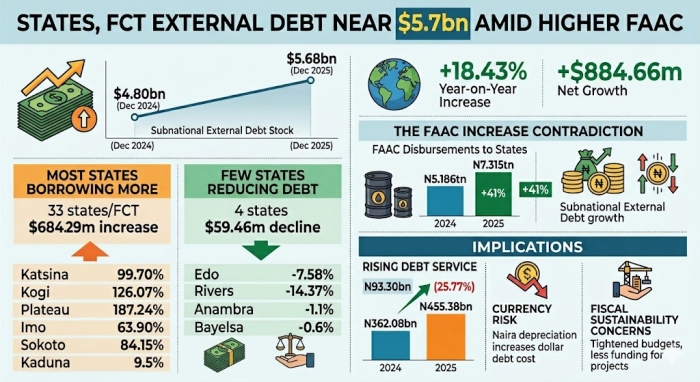
A significant surge in external borrowing has pushed the combined foreign debt of Nigeria’s thirty-six states and the Federal Capital Territory to nearly $5.7bn by the end of 2025. This 18.43 percent year-on-year increase occurred despite a substantial boost in revenue from the Federation Account Allocation Committee (FAAC). Data from the Debt Management Office reveals that subnational external debt stock grew from $4.80bn in late 2024 to $5.68bn just twelve months later, representing a net increase of over $884m.
The borrowing trend was nearly universal, with thirty-three out of thirty-seven subnational entities recording higher debt positions. While states like Edo and Rivers managed to reduce their external liabilities by $29.02m and $28.69m respectively, these modest declines were heavily outweighed by aggressive borrowing elsewhere. Katsina and Niger both more than doubled their debt stocks, while Plateau recorded the highest percentage jump at over 187 percent. Lagos remains the most indebted state in absolute terms at $1.17bn, though it maintained a cautious stance with only a marginal 0.41 percent increase in its foreign obligations.

This appetite for foreign loans coincides with a period of unprecedented domestic revenue growth. Driven by higher oil prices, the removal of the petrol subsidy, and naira devaluation gains, total FAAC disbursements to states jumped by 41 percent to reach N7.315tn in 2025. Including the 13 percent derivation revenue, total state-linked receipts climbed to approximately N9tn. However, instead of using these windfalls to deleverage or fund infrastructure, many states have deepened their reliance on external financing to manage fiscal pressures and rising recurrent expenditures.


Financial experts and transparency advocates are sounding the alarm over the long-term implications of this debt trajectory. Nigeria Extractive Industries Transparency Initiative (NEITI) recently pointed out that many states with the highest debt-to-revenue ratios are those receiving lower-tier FAAC allocations, creating a precarious fiscal imbalance. Furthermore, the cost of servicing these loans has ballooned, with states paying out over N455bn in foreign debt service in 2025 alone. This represents a 25 percent increase in deductions compared to the previous year, leaving less room in state budgets for essential services like healthcare, education, and capital projects.


Analysts warn that the heavy reliance on dollar-denominated debt leaves states highly vulnerable to further currency fluctuations. Every dip in the value of the naira automatically inflates the cost of repayment, potentially mortgaging future federal allocations to satisfy international creditors. Economic experts suggest that rather than defaulting to borrowing, states must prioritize improving their internally generated revenue systems and explore more sustainable, equity-like long-term financing structures to avoid a full-scale fiscal crisis.
SOURCE: NEWS SCROLL