The LYNX EYE-NEW February 15, 2026 Electoral Integrity: Akpabio has something to hide. By Taiwo Adisa
The LYNX EYE-NEW February 15, 2026 Electoral Integrity: Akpabio has something to hide. By Taiwo Adisa
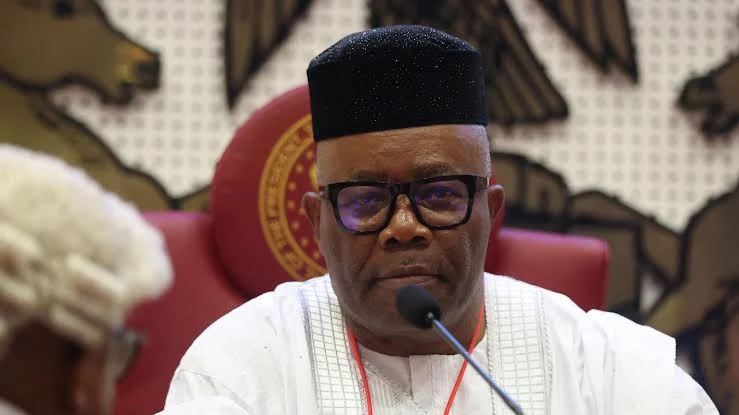
The drama that pitched the Senate of the Federal Republic of Nigeria against the people, starting from February 4, is instructive as it equally says much about where our Senators stand on the issue of electoral integrity. Though the lawmakers showcased a Pontius Pilate scenario by attempting to back off due to intense heat from the people of Nigeria, what happened on the floor of the Senate on February 4 and Senate President Godswill Akpabio’s audacious taunt, with his ‘we cannot be intimidated declaration’ on February 7, clearly indicates where each of the lawmakers stand on the issue of electoral integrity going forward.

Some readers would prefer that my topic doesn’t single out Akpabio, because many senators who were as guilty as their president merely played the ostrich, the fact that Akpabio orchestrated the widely condemned bid to thwart the sanctity of the votes in the first instance should make him the fall guy.

There was supposed to be nothing to argue or haggle about, so to speak, over the electoral reform expected in Nigeria, post 2023 election. The 9th National Assembly appeared to have done a good job by passing a law that guaranteed the use of a result viewing portal, iREV, by the Independent National Electoral Commission (INEC). The existing law also approved the use of electronic components such as BVAS by the electoral body, in addition to the adoption of the Card Reader from the previous elections. At the close of the presidential election petition in October 2023 and the governorship petitions in January 2024, however, it has emerged that the major point of mischief the nation needed to correct to clear doubts on the integrity of its elections is to ensure the sanctity of the BVAS and iREV as electoral accountability tools. What the Supreme Court concluded was that whereas the two electronic tools were adopted by INEC for the conduct of the election, their use was not made mandatory by the Electoral Act, and as such, election results cannot be invalidated on account of the failure/refusal of an electoral officer to utilise them. Going by the assignment, the two election components were meant to serve; anyone following the pattern of elections in Nigeria would easily identify their capacity to ensure election integrity. The BVAS is designed to capture accredited voters in a polling unit and transmit the number of accredited voters to a central server. The iREV, on the other hand, is intended to warehouse election results from each polling unit across the country. What the assembly needs to do is to remove the discretionary powers from INEC and electoral officials in handling these tools.


In clear terms, therefore, while the BVAS tells us the number of accredited voters and the number of registered voters in the particular polling unit, the iREV allows us to view the tabulated results scored by each of the political parties at the polling unit. Regardless of the inadequacies that may still be inherent in these tools, the fact that voters can connect with their votes via the iREV is a source of satisfaction that a step on the path of credible elections has been taken. So the task before the 10th National Assembly was already clearly spelt out at least from January 2024. The amendments needed to produce the Electoral Act 2025 are not as humongous as those we had in 2019 and 2022, but somehow, Akpabio constituted and reconstituted his Committee on Electoral Matters, and after the series of rigmarole, he only landed in further rigmarole.

We were made to understand that the Senate and the House of Representatives carried themselves along in the process, leading to the production of the proposed amendment bill being considered by the lawmakers. There were many joint sittings of the committees both in the National Assembly and at other sessions organised by the Parliamentary Monitoring Organisations (PMOs). One of the outcomes of those sessions was the proposed Section 60(3) as passed by the House of Representatives. It reads: “The designated election official shall electronically transmit all election results in real time, including the number of accredited voters, directly from the polling units and collation centres to a portal, and the transmitted result shall be used to verify any other result before it is collated.” Instead of the above, the Senate came up on February 4 with a version, which it said imitated the 2022 Electoral Act. In the first instance, if all the Senate would come up with is to repeat the 2022 Electoral Act, Nigerians are bound to ask, why take the Act through a needless amendment process? The Senate version passed on February 4, as contained in Section 60(5) reads: “The presiding officer shall transfer the result, including the total number of accredited voters and the result of the ballot, in a manner as prescribed by the Commission.”
Even if you don’t want to express anger with the lawmakers’ discretion to retain the provision of the Electoral Act 2022, to say that the decision was a product of at least two executive sessions is an attack on our sensibilities. Why does the Senate need to lock the doors just to thrash out in an already existing law if Akpabio has nothing to hide? I smelt a rat as soon as we started seeing the lawmakers close and open their doors and coming out with sealed lips in those early days of February. This is because the processes known to lawmakers are the first reading, second reading, public hearing, and third reading. For the chamber to take itself through some rigours of close/executive sessions after a standing or ad hoc committee had submitted its report is clearly superfluous. The business of lawmaking is to be done in the open, and the gavel must be seen to have hit the table. Meetings behind closed doors are usually associated with ways and means issues, or, in the language of this senate, ‘sending of emails, prayers for safe arrival at destinations’. According to Akpabio, the Senate retained electronic transmission of results in the format it was contained in the Electoral Act, 2022, because it was trying to protect election results from running into chaos of network failure.

The Senate President prompted his Chief Whip, Senator Mohammed Mongunno, to whip the law into line when the latter moved a motion substituting the real-time transmission with the word ‘transfer’ as contained in the 2022 Electoral Act. The motion was promptly seconded by the Deputy Senate President, Senator Barau Jibrin, and it was passed by senators. Akpabio was to later adopt doublespeak when he said in his closing remarks: “What we have done is to retain electronic transmission, which has always been in our law. This Senate, under my watch, will not reject electronic transmission of results.” To further show his hands, however, the Senate President went ahead to announce the composition of a nine-member conference committee, which will harmonise the bill with the House of Representatives, naming Senator Mohammed Mongunno as chairman instead of the chairman of the Committee on Election Matters, Senator Simon Lalong. A huge protest championed by Senator Ali Ndume and Lalong himself eventually forced Akpabio to change the misnomer of a senatorial conduct. Since the start of democratic rule in 1999, every Senate president has operated the rules of the Senate in line with constitutional provisions and parliamentary conventions. The chairman of a standing committee cannot logically be sidelined in the composition of the conference committee of the bill midwifed by his committee, and you bring in a principal officer, just to the extent of his ‘principalness’. That’s antithetical, and I like the fact that Ndume opposed this strongly. Was Akpabio trying to push forward Senator Mongunno to finish off his attack on transmission (real-time) in favour of ‘transfer’ at the conference?
Good enough, Nigerians refused Akpabio’s crusade and the ‘too young for e-transmission’ mantra by rising in unison, the civil society, the youths, political faces and forces, and personalities, all insisted that e-transmission was ripe in this country. The Occupy NASS rallies started on Monday, February 9, coincided with the Senate’s decision of February 10 to rescind the decision to reject e-transmission.
Even though activists like Comrade Ezenwa Nwagwu, Executive Director of the Peering Advocacy And Advancement Centre in Africa PAACA) are of the view that e-transmission of results to the iREV is not enough guarantee for electoral integrity because iREV lacks computational facilities, the fact that Nigerians, supported by minority senators led by Senator Enyinnaya Abaribe, gave it to Akpabio wotowoto, means that the Man in the Nigerian people did not die and that the voices that sang ‘on June 12 we stand’ have not been drowned by the vicissitudes of the time.