TikTok, NUJ train Oyo journalists to tackle election misinformation ahead of 2027 polls Stakeholders urge media practitioners to verify digital content, guard against fake news
TikTok, NUJ train Oyo journalists to tackle election misinformation ahead of 2027 polls Stakeholders urge media practitioners to verify digital content, guard against fake news
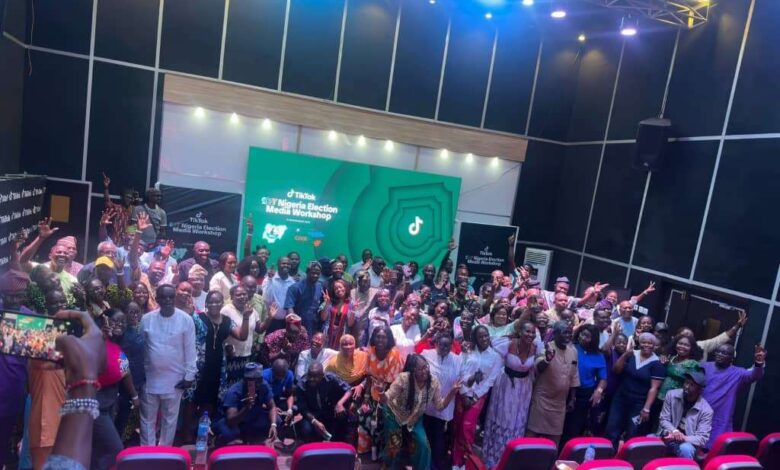
As concerns grow over the spread of misinformation and misleading content on social media ahead of the 2027 general elections, TikTok and the Nigeria Union of Journalists (NUJ), Oyo State Council, have trained 150 journalists in Oyo State on election integrity and responsible digital reporting.
The training, held on Friday at the Donion FM Hall, Iyaganku, Ibadan, was aimed at equipping journalists with the skills to identify and counter election-related misinformation, authenticate digital content and use emerging platforms effectively for news dissemination.

Speaking at the workshop, TikTok representative from Johannesburg, South Africa, Giyahile Makhoba, said collaboration between technology platforms and media organisations was necessary to ensure that citizens had access to credible information, particularly during elections.

She said the training was part of TikTok’s commitment to helping journalists understand its platform and use its features to reach wider audiences.

Makhoba, who disclosed that she had worked with TikTok for about five years, said the platform had grown beyond its initial perception as an entertainment space for young people to become a community serving people across different age groups and interests.
She noted that the increasing use of TikTok for news dissemination by journalists made it important for media practitioners to understand how the platform works and how to maximise its opportunities.
On election integrity, she stressed the need for cooperation among journalists, technology companies, civil society organisations, regulatory agencies and the Independent National Electoral Commission (INEC) to tackle the spread of false information.
According to her, TikTok’s responsibility during elections goes beyond providing a platform for users, as it also involves protecting communities, empowering users and working with relevant organisations to ensure that accurate and timely information reaches the public.
Makhoba said, “It is about protecting users, empowering communities and working with relevant organisations to make sure that accurate and timely information gets to the public during elections.”
She explained that TikTok operated established Community Guidelines and content policies to regulate activities on the platform, adding that content not appearing on users’ For You feeds was not necessarily removed for violating its rules.
She said some content might simply not meet the platform’s recommendation requirements, stressing that content moderation was guided by established standards rather than arbitrary decisions.
The TikTok representative also introduced Melody and OEME as members of the company’s support team who would remain available to assist participants with questions and challenges after the workshop.
She announced that Code for Africa, TikTok’s long-standing fact-checking partner, would also contribute to the training, describing its role as important in addressing misinformation.
In his remarks, the NUJ Chairman in Oyo State, Comrade Akeem Abas, described the partnership as an investment in journalism, democracy and the credibility of the electoral process.
He urged the participants to make effective use of the knowledge acquired and share it with colleagues in their respective newsrooms.
Abas said the union was committed to embracing technological innovations without compromising the ethics and professional standards of journalism.
He warned journalists against confusing online popularity with professional credibility, noting that large followership, digital visibility and viral content did not automatically make information accurate.
He said, “Digital visibility, virality and large followership should never be mistaken for credibility.”
The NUJ chairman further charged journalists to verify information, authenticate digital materials and critically examine political claims before publishing them.
He warned that unverified reports, particularly during election periods, could heighten tensions, mislead voters and weaken public confidence in the electoral process.
Abas maintained that while journalists must adapt to emerging technologies and changing patterns of news consumption, their responsibility to truth, accuracy and public accountability must remain paramount.