Nigeria needs leaders, not rulers – Education advocate calls for early leadership training
Nigeria needs leaders, not rulers - Education advocate calls for early leadership training
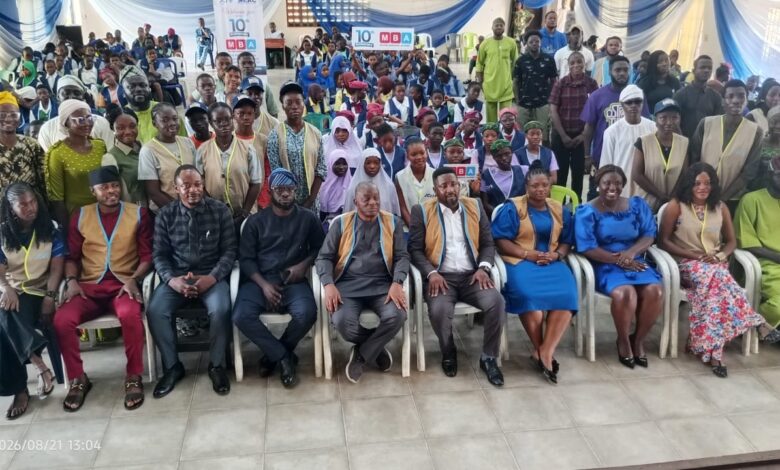
An education advocate and founder of the Muyiwa Bamgbose Academy (MBA), Pastor Muyiwa Bamgbose, has called for the early grooming of leadership qualities among Nigerian youths, saying the country needs responsible leaders rather than rulers who will compound its socio-economic and governance challenges.

He made the call on Friday at the grand-finale of the 10th anniversary of the Muyiwa Bamgbose Academy and its 11th edition, held at Government College Ibadan, Apata, Ibadan, Oyo State.


The five-day programme, held from August 17 to 21, 2026, was organised in conjunction with Junior Chamber International (JCI) Ibadan as an intensive leadership training and mentorship academy for secondary school prefects across Oyo State.
The education advocate, who is also the founder of the Educational Advancement Center, Ibadan, said Nigeria’s leadership challenges could be addressed more sustainably by developing responsible leaders from a young age rather than waiting until individuals had assumed positions of authority.


He said, “I think we make a mistake when we want to begin to mould leaders at a certain age.“
“We say a fool at 40 is a fool forever. You know, it looks somehow, but the fact is this. If we can imbibe leadership qualities and characteristics in people at a tender age, they will grow up to become responsible leaders.”
According to him, early leadership development is not only more effective but also cheaper than attempting to reform individuals after they have acquired responsibilities and influence in society.
“It’s better to catch them more, you know. And it’s also cheaper than waiting until they are now responsible people. They have responsibilities heaped upon them.”
He explained that young people who were taught to become problem-solvers before assuming major responsibilities would be more likely to retain such qualities when they eventually occupied positions of influence.
“What if they have imbibed that character of solving problems when they were carefree? Somebody pays your school fees. Somebody feeds you.“
“But it becomes part of you to be a problem solver. By the time you become responsible, you continue being a problem solver,“ he said.
The education advocate said Nigeria needed more initiatives aimed at developing responsible young leaders and urged governments to replicate such programmes across the country.
“I wish that more people would imbibe this kind of programme. I’m sure I’m not the most endowed person to run this kind of programme. So the government is there. You know, they can take this issue, go to every nook and corner.“
“Starting from your state, it can go to the whole federation. You know, the fact is that we need leaders. We need leaders.”
He stressed that young people needed to be equipped with the right values before they became exposed to negative influences that could encourage them to compromise standards and abuse positions of authority.
“The best way to get your leaders is to catch them young before they are polluted. Once they get into the society proper, people will show them all kinds of ways to cut the corners, to bend rules. And they will become the rulers that we don’t need,” he said.
The advocate said the leadership academy was established to provide a practical pathway for identifying young people with leadership potential and equipping them with the knowledge and skills needed to serve effectively.
He recalled that the initiative originated from discussions about how to move beyond conventional interventions and establish a programme capable of building lives and preparing young people for leadership.
“All these projects that we have been having, all kinds of things, donation, anti-tobacco laws, so many projects, sometimes toilets, why don’t we look at a project that will build lives, that will equip people to become leaders.”
He explained that the philosophy behind the programme was based on the principle that developing people to solve problems was more sustainable than continually providing temporary solutions.
“Because when you have good leaders, all the problems that we are trying to solve will be taken care of. So if we are always solving the problems, it’s like giving a man a fish. Every day you give him a fish, but if you teach him how to fish, you’ll feed him forever,” he said.
He said secondary school prefects were deliberately selected because their appointment suggested that they had already demonstrated qualities that could be further developed through structured leadership training.
“Anyone who becomes a prefect in a school must have demonstrated some wonderful qualities. The teachers would have seen some traits in that person,” he said.
“So if we get such people, we polish them and we train them on how to lead properly. Then they can go back to their schools, lead well in that year as prefects, and go on with that into the university and into life itself, work life.”
Speaking on the lessons from the 2026 training, he said the students were taught to take ownership of problems around them instead of blaming others for challenges confronting their schools and communities.
“The first thing is that they own the problem. Stop blaming people,” adding, “You know, it’s an African syndrome, we blame other people for whatever is wrong. You know, we don’t think of what we can do about it. So the number one principle is you own the problem where you are. There’s something you can do about the problem before other people can join you.”
He said the students were also taught how to identify societal problems and develop practical solutions to them, noting that effective leadership required an understanding of the actual needs of the people being served.
“Many times, people in leadership, do what they think the people need. They do what they think matters. Whereas there are more serious issues that are unattended to,” he said.
“So these kids are sensitised to know how to identify problems and then go on to provide solutions to those problems.”
“Other areas covered during the programme included leadership branding, influencing others, teamwork, environmental responsibility, personal hygiene and entrepreneurial skills.“
He said entrepreneurial training was particularly important because many students in public schools came from needy homes and could benefit from acquiring skills capable of helping them support themselves and their families.
“They learn some skills, some entrepreneurial skills. Some small businesses they can lay hands on to do, even as students. You know, something that you can use to support yourself.“
“Because we realise that most students in the public schools are from needy homes. And so they are also encouraged and trained to support the home when they get back.”
On the future of the initiative, the education advocate said the focus should move beyond the five-day annual training to continuous leadership development within schools and communities.
He welcomed efforts by the junior team to extend the programme to Government College Ibadan and Queen’s School, describing the initiative as a starting point for a wider expansion.
“I’m happy that the junior team by itself is doing something that is in my mind. That is taking it to the schools. It’s not enough to just train the people.“
“Because these five days that they spend, they may not have learned enough or practised enough. But if we can get them to the community, to the schools themselves.”
He added, “We also look at other schools. And I promised all those students, all those scholars, that I would personally visit their schools. I’ll visit them in their schools.”
He said taking the programme to schools across the state would provide a wider platform for reaching young people and creating a sustained culture of responsible leadership.
“So what we need to do is to drive it down, to give it a pace, you know, in every school. Because these schools are scattered across the communities. So you have a way of reaching the whole state if you can reach all the schools,” he said.
He appealed to individuals and organisations with the capacity to support the initiative to partner with it or replicate the model in their communities.
“We are pleading that people who have the means, they can partner with us. They can also decide to run their own mission with it.“
“We can give them support and consultancy on what we’ve seen, what we’ve done. We can even give them volunteers who will train, you know, so that this country can be a better place,“ be said.
Earlier, the President of JCI Ibadan, Aiyedogbon Oluwaseun, said the scholars had been exposed to the true meaning of leadership during the five-day programme.
He reminded the prefects that their positions were not merely ceremonial but carried responsibilities to serve their fellow students with integrity, empathy and purpose.
“Over the past few days, the scholars at the Muyiwa Bamgbose Academy have discovered the true leadership. As prefects, your title is not just a privilege, it is a call to service, integrity, and empathy,” he said.
Oluwaseun urged the students to lead by example, listen to those they serve and ensure that their tenure leaves a positive impact on their schools.
“To lead with purpose, to lead by example, you earn respect through your actions. To lead by listening, pay attention to those you serve. You lead by impact, you leave your school better than you have found it,” he said.
He expressed appreciation to the trainers, school administrators, JCI team and the founder of the academy for their contributions to the success of the programme.
Addressing the graduating scholars, the JCI president stressed that the end of the training marked the beginning of their responsibility as young leaders.
“To all our graduates, your training ends today, but your leadership starts now. Go out, inspire your peers, and make us proud,” he said.
The grand-finale featured testimonials from past scholars, presentation of gifts and presentation of certificates to the graduating participants.