Nationwide Blackouts Deepen as Nigerians Endure Hours Without Electricity
Power Crisis Worsens as Nigerians Get Less Than Three Hours of Electricity Daily
“We Hardly Get One Hour of Electricity”: Nigerians Decry Worsening Blackouts Amid Heatwave
A deepening electricity crisis across Nigeria is leaving homes and businesses in darkness as residents struggle to cope with prolonged blackouts and rising temperatures.

Across several states—including Kano, Kaduna, Sokoto, Enugu, Benue, Oyo, Akwa Ibom, Taraba, Lagos and Ogun—citizens say electricity supply has deteriorated sharply in recent weeks, forcing many households and businesses to abandon reliance on public power and turn instead to generators and solar alternatives.

For millions of Nigerians, the outages have made routine daily activities increasingly difficult. In many homes, fans and air conditioners remain idle despite intense heat, while small businesses that depend on electricity are either shutting down or operating under heavy financial strain.


Energy analysts say the persistent outages expose deeper structural problems within Nigeria’s electricity sector, including inadequate gas supply to power plants, weak transmission infrastructure and chronic underinvestment throughout the power value chain.
Residents report minimal supply
In Kano State, residents of Unguwa Uku and Hotoro Dan Marke say electricity supply has dropped to barely one hour a day.
Ahmad Ibrahim, who lives in the area, said the little power available usually arrives late at night.
“We hardly get electricity for more than one hour. Sometimes it may last two hours, but most times it comes late at night,” he said.
In Sokoto State, residents describe an even more severe situation. Communities such as Mabera, Tamaje, Old Airport, Sahara, Emir Yahya and Tudun Wada say they receive less than one hour of electricity daily.
Musa Abdullahi, a resident of Mabera, said the situation has become particularly difficult during the Ramadan fasting period.
“Because of the heat and fasting, people now depend on neighbours who have solar power to buy ice blocks or cold water,” he said.
Residents also complain that areas classified under the Band A tariff—where consumers are expected to receive at least 20 hours of electricity daily—are receiving far less than the promised supply.
Businesses struggle to survive
In Enugu State, where many customers recently migrated to the expensive Band A tariff category, consumers say supply remains far below expectations despite higher electricity bills.
Chinedu Okafor, a resident of Emene, said households are paying premium tariffs but receiving between four and ten hours of electricity daily.
“How can people pay the highest tariff when electricity comes for only four hours?” he asked.
For small businesses, the financial impact has been severe.
Amaka Nwosu, who operates a business in Nsukka, said rising generator costs are eroding profits and slowing production.
“The cost of running generators is killing our business. Production has slowed and expenses keep rising,” she said.
In Makurdi, Benue State, unreliable electricity has already forced some businesses to close.
Attah, a resident of the Adeke area, said his wife’s frozen food business collapsed after repeated power outages destroyed her inventory.
“My wife sells frozen meats, but the business collapsed because the electricity supply became too unreliable,” he said.
Erratic power across states
Residents in Akwa Ibom State report similar challenges. In areas such as Aka Etinan, the Uyo metropolis, Oron Road and the Nwaniba Road corridor, electricity supply has remained erratic for years, with some communities receiving less than three hours of power daily.
Miss Ekaete Akpan, a resident of Aka Etinan, said the irregular power supply has become a major obstacle for small businesses.
“Even when electricity comes, it hardly lasts up to three hours,” she said.
She added that supply often arrives at inconvenient hours when most businesses are closed.
“It normally comes around 3am and disappears by 6 or 7am. After that, you may not see electricity again until late at night.”
In Oyo State, residents across the Ibadan metropolis say erratic electricity is slowing economic activity.
Kunle Ajala, a resident of Moniya, said the community had gone nearly a week without stable power.
“Even when power comes, it may not last up to three hours,” he said.
Artisans whose livelihoods depend on electricity say the impact has been particularly severe.
A barber, Bisi Adeoye, said poor supply has crippled his business despite continued high electricity bills.
“I depend on electricity for my business, but it has not been moving well for some time now and they still send high bills,” he said.
In Kaduna State, residents say frequent outages are causing food spoilage and financial losses.
Mrs Martina Aji, who lives in Sabo in Chikun Local Government Area, said food stored in her refrigerator spoiled after days without electricity.
“Since last week, we have hardly had electricity. Food items, especially soup, have spoiled in my refrigerator,” she said.
Households count losses
For many households, the blackout has translated directly into financial hardship.
A resident in Obafemi Owode Local Government Area of Ogun State said food worth about N100,000 stored in his freezer went bad after three days without electricity.
“I had to pour everything away because there was no power for three days. It was painful, but I had no option,” he said. “And I am not alone. There are many people like me. Who will compensate us for this?”
Frustration over the situation has also spilled onto social media, where users have responded with satire and criticism.
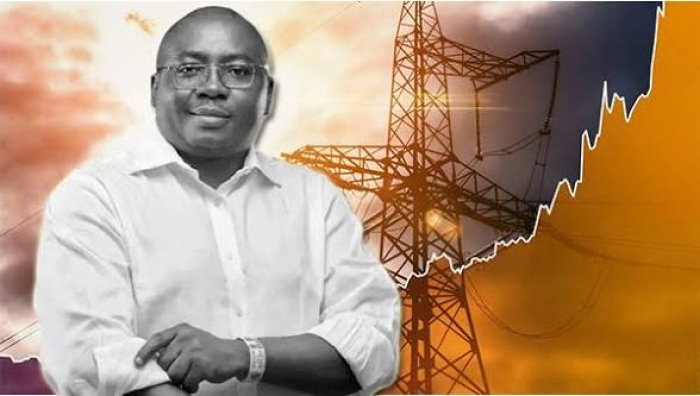
One viral post featured an artificial intelligence–generated image portraying the Minister of Power, Adebayo Adelabu, as the “Olokunkun of Okunkun Kingdom,” a symbolic king of darkness.
Other posts depicted electricity distribution companies issuing bills during blackouts or citizens embracing transformers in hope of power restoration.
Structural problems persist
Experts say Nigeria’s electricity crisis reflects deep structural challenges within the power sector.
Although the country’s installed generation capacity exceeds 12,000 megawatts, actual output frequently falls below 4,000 megawatts—far short of what is required to meet the needs of a population of more than 220 million.
Energy analysts estimate that Nigeria requires at least 30,000 megawatts of stable electricity to support economic growth and industrial development.
Frequent grid collapses and transmission bottlenecks further limit the amount of electricity that reaches consumers.
As a result, Nigeria has become one of the world’s largest markets for backup generators. Industry estimates suggest that more than 80 million households and businesses rely on petrol or diesel generators, creating a backup power market valued at over $10bn annually.
Electricity distribution companies say part of the current shortage is linked to reduced gas supply to power plants.
The Kaduna Electricity Distribution Company recently informed customers that gas supply constraints had reduced power generation, forcing the company to increase load shedding across its franchise areas, including Kaduna, Katsina, Kebbi, Zamfara and Sokoto states.
“We are currently experiencing a reduction in power supply due to gas supply constraints affecting power generation,” the company said.
Presidential Villa turns to solar power
Amid the worsening power crisis, the Presidential Villa in Abuja is testing a major solar power project aimed at reducing its reliance on the national grid.
Officials at the State House say the solar system recently installed at the complex is still undergoing technical testing and has not yet reached full operational capacity.
The project follows earlier assurances during the 2026 budget defence that the Presidential Villa would transition away from the national grid by March.
According to officials familiar with the project, the solar system must complete a testing phase before the complex can disconnect from the national grid.
The initiative forms part of a broader effort to reduce the rising cost of diesel and generator maintenance at the State House.
Budget records show that the State House spent about N5.35bn between 2023 and 2026 on electricity bills, generator fuel and maintenance.
Following the removal of fuel subsidy in 2023, the cost of generator fuel increased sharply, rising from tens of millions of naira to nearly N2bn annually.
To address these rising expenses, the Federal Government approved N17bn for the solarisation of the Presidential Villa—allocating N10bn in 2025 and including N7bn in the 2026 Appropriation Bill.
Officials maintain that the move to solar energy does not indicate a loss of confidence in the national grid but is intended primarily to cut operational costs and ensure uninterrupted electricity supply within the State House complex.